

Renewed at the Table of the Lord
A Two-Year Journey of Liturgical Renewal | Diocese of San José
We are embarking on a journey together — to encounter Christ more fully in the Mass, to deepen our participation in the Eucharist, and to worship as one Body. Walk with us.
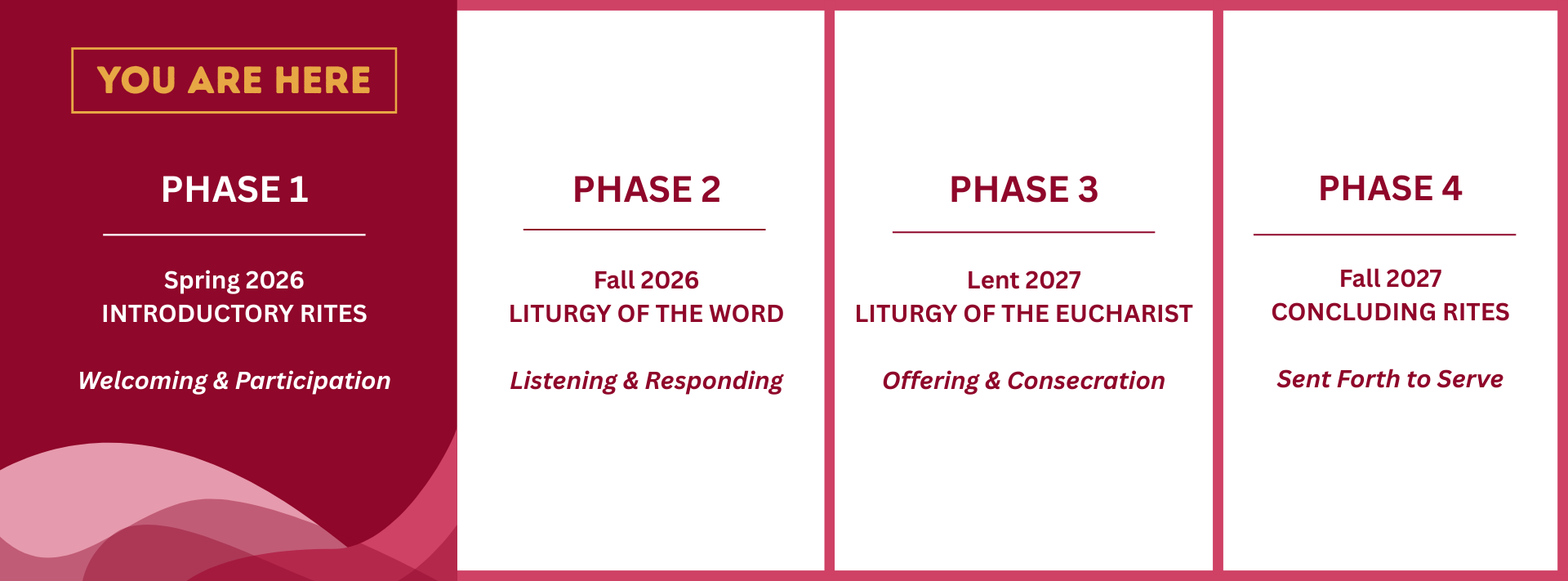
Our Journey Together: The Four Phases
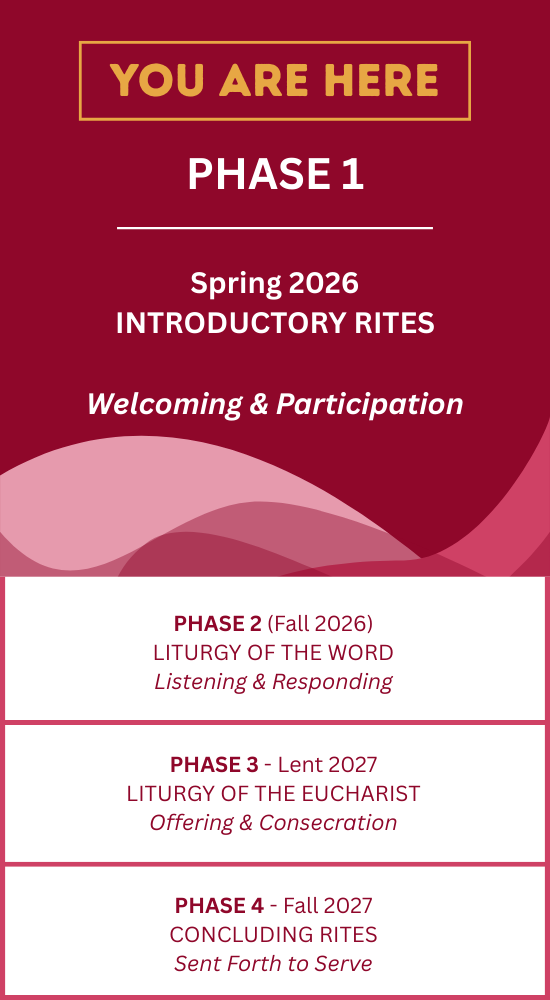
Our Journey Through the Mass — Four Phases, Two Years Over the next two years, we will walk together through the entire Mass — season by season. Here is where we are and where we are going:
Bishop’s Message
Renewed at the Table of the Lord: Beginning Our Journey of Liturgical Renewal
Dear Brothers and Sisters in Christ,
Let me share something with you that I rarely say aloud: even for me, after years of celebrating Mass, there are days when I arrive at the altar and realize I have let the mystery of God’s love slip past me. The words are familiar. The gestures are routine. And yet, somewhere between arrival and the final blessing, distracted by the issues of life, I have gone through the motions rather than reflecting consciously on the sacred mysteries celebrated. I suspect I am not alone in this. While the sacrament is still effective in these cases, we do not spiritually profit from the encounter as if we were attentive.
What Is Liturgical Renewal?
What Is Liturgical Renewal? You may be hearing the words “liturgical renewal” for the first time. Here is what it means in simple terms: over the next two years, our diocese will reflect on each part of the Mass as part of our greater Pastoral Plan journey of spiritual renewal. Each season spotlights one part of the Mass, diving into its meaning, its beauty, and how we can participate more fully as a community. Rest assured, liturgical renewal is not about criticizing how anyone has been worshipping. It is an invitation to spiritual renewal—to experience the Mass more deeply and participate more fully in the Eucharist, the source and summit of our Catholic life. The Second Vatican Council called all of us to participate fully, consciously, and actively in the liturgy — bringing our whole selves to Mass: our hearts, our voices, our attention, and our lives. This renewal is our response to that call, as the Body of Christ gathered to worship as one family.
Phase 1: Introductory Rites
Phase 1 — Spring 2026: Introductory Rites
From April 12 through summer 2026, we focus on the opening moments of the Mass, the moments that gather us from being individuals into being the Body of Christ.
These are the Introductory Rites: the entrance procession, the greeting, the Penitential Act, the Gloria, and the Collect (Opening Prayer). You experience them every Sunday. This spring, we are inviting you to notice them, understand them, and enter into them more fully.
The Entrance Procession
The Mass begins not when the priest reaches the altar, but the moment you walk through the church door — and even before, as you prepare your heart at home.
In the entrance procession, the crucifix, the cross bearing the body of Christ,leads the way. Christ goes before us, showing us the path. Two candle bearers follow, their flames pointing to Christ, the Light of the World. Most significantly, the Gospel Book is carried high with dignity and reverence — it contains the very words of Christ, who will speak to us.
As the procession moves through the church, we sing the entrance song together. This is not background music — it is prayer. When we raise our voices in song, we are literally becoming one body.
Your Ministry as a Member of the Assembly
Did you know that every person who comes to Mass has a ministry? You do not need to be a lector or choir member. Your presence, your voice, your prayer, your attention — these are your ministry.What the Church asks is not a performance but an interior offering: bringing yourself, honestly, to this encounter with the living God.
When you stand with your brothers and sisters during the Introductory Rites, your shared posture is a sign of unity. When you respond to the prayers, your voice joins the voice of the whole Church. When you sing, you are praying.
Music: Praying Twice
St. Augustine taught that ‘those who sing pray twice.’ Music at Mass is not a performance — it is ministry. Our music ministers — choirs, cantors, instrumentalists — are not here to fill the silence with beautiful sound. They are here to draw you in. When you add your voice, they have done their job. And over time, the song does not only express what we believe. It shapes it. Your voice belongs here.
The Greeting
The very first words spoken at Mass are not a formality — they are a two-way proclamation. The priest turns to the assembly and says: “The Lord be with you.” And the assembly responds: “And with your spirit.” In that exchange, the whole theology of the Mass is expressed: Christ is present in the assembly, and about to be made present in the Eucharist. Through both, he heals the world. This Sunday, receive the Greeting not as an opening pleasantry, but as the declaration it is.
The Penitential Act and Gloria
After the greeting, we pause for the Penitential Act — a moment to acknowledge our need for God’s mercy with humble and honest hearts. We come before the Lord not pretending to be perfect, but as beloved children who know we need His grace.
On most Sundays, we then burst into the Gloria — an ancient hymn of praise nearly two thousand years old. From confession to praise — this is the rhythm of the Christian life.
The Collect — Our Prayers Gathered as One
The Introductory Rites conclude with the Collect, or Opening Prayer. After a moment of silence — your moment to bring your own intentions to God — the priest prays on behalf of the entire assembly. Your prayers and mine rise together to the Father. We are not alone.
How You Can Prepare
How to Prepare Before Sunday
Here are five simple ways to enter more fully into the Mass this spring:
 Arrive 5–10 minutes early. Give yourself time to quiet your heart and prepare to encounter the Lord.
 Bring your whole self. Set aside your phone. Leave the week behind. You are about to meet Christ.
 Look up the readings beforehand. A few minutes with Sunday’s Gospel before you arrive can open your heart to hear it more deeply at Mass.
 Join the Gathering Song and ever song. Your voice matters, even if you think you cannot sing. When we sing together, we pray together.
 Notice the entrance procession. Watch the crucifix, the candle bearers, the Gospel Book carried with reverence. Let these symbols speak to you.
 Respond with conviction. Your “Amen,” your “And with your spirit,” and your “Lord, have mercy” are not formalities. They are your voice, joining the voice of the whole Church.
The Mass is not something we attend. It is something we enter into — together, as one family.