San Jose
|
Holy Thursday |
Good Friday |
Easter Vigil |
Easter Sunday |
Cathedral Basilica of St. Joseph
80 S. Market St.
408.283.8100
https://www.stjosephcathedral.org/
Livestream Link:
Facebook |
HOLY THURSDAY
- 7:30 PM to 8:30 PM Eucharistic Adoration on Fridays of Lenten following Benediction | Parish
- 12:45 PM Eucharistic Adoration following Benediction 1st Fridays after daily Mass at noon.
- 7:00 PM Mass of the Lord’s Supper | Parish | Bilingual | Livestream
- ALTAR OF REPOSE – 8:30 PM to Midnight: Adoration & ending with Night Prayer | Loyola Hall
|
GOOD FRIDAY
- 12:00 PM Stations of the Cross
- 1:00 PM Prayer
- 2:00 PM Good Friday Liturgy | English | Livestream
- 7:00 PM Good Friday Liturgy | Liturgia de Viernes Santo | Spanish | Livestream
|
EASTER VIGIL
- 8:30 PM Easter Vigil Mass | Bilingual | Livestream
|
EASTER SUNDAY
- 8:30 AM Mass | English
10:00 AM Mass | Spanish
11:30 AM Mass | English| Livestream
1:00 PM Mass | Spanish | Livestream
|
Christ the King
5284 Monterey Rd.
408.362.9958
http://ctksj.org/
|
HOLY THURSDAY
- 7pm Mass of the Lord’s Supper, Trilingual.
- ALTAR OF REPOSE ––in the Parish Hall, from 8pm to 11pm.
|
GOOD FRIDAY
- 12pm Estaciones de la Cruz en Español.
- 1pm- Stations of the Cross in Vietnamese
- 2pm-Station of the Cross in English
- 3pm Celebration of the Lord’s Passion in english
- 4:30pm -Celebration of the Lord’s Passion in Vietnamese
- 6:30pm-Celebracion de la Pasion del Señor en Español.
- 7:30pm -The Lord’s Passion Performance.
|
EASTER VIGIL
- 8:30pm Easter Vigil Mass, Trilingual.
|
EASTER SUNDAY
Regular Sunday Schedules:
- 8am -Spanish
- 9:30am-English
- 11am-Vietnamese
- 1pm Spanish
- 3pm Vietnamese
- 7pm Spanish
|
Church of the Transfiguration
4325 Jarvis Ave.
669-274-6530
www.sanjosetransfig.org
|
HOLY THURSDAY
- 7:00pm Mass of the Lord’s Supper, English
- ALTAR OF REPOSE – in Tabor Hall till 10:00pm
|
GOOD FRIDAY
- Stations of the Cross 12:00/Noon
- 3:00pm Celebration of the Lord’s Passion
|
EASTER VIGIL
|
EASTER SUNDAY
- 9:30am English – Church
- 11:00am English – Church
|
Five Wounds Portuguese National Church
1375 E. Santa Clara St.
408.292.2123
http://www.fivewoundschurch.org
Livestream Link:
Facebook |
HOLY THURSDAY
- 7:00 pm Mass of the Lord’s Supper, Portuguese/English – Indoor/Livestream,
- ALTAR OF REPOSE – Five Wounds Portuguese National Church, Altar of Our Lady of Mount Carmel, after the end of the Mass of the Lord’s Supper until 11:00 p.m
|
GOOD FRIDAY
- 3:00 p.m. Celebration of the Lord’s Passion, Portuguese/English Indoor/Livestream
- 7:00 p.m. The Passion Play by Youth Confirmation Candidates and Procession of the Lord’s Burial, Portuguese/English, Indoor and Outdoor (around the church)/Livestream
|
EASTER VIGIL
- 8:30 p.m. Celebration of the Easter Vigil, Portuguese/English/Spanish, Indoor/Livestream
|
EASTER SUNDAY
- -9:00 a.m. English – Indoor/Livestream
- 10:30 a.m. Portuguese – Indoor/Livestream
- 5:30 a.m. Latin (Novus Ordo) – Indoor/Livestream
|
Holy Cross
580 E. Jackson St.
408.294.2440
https://holycrosssj.com/
Livestream Link:
https://holycrosssj.com/
|
HOLY THURSDAY
- 6:00 PM Mass of the Lord’s Supper, English
7:30 PM Misa de la Cena del Señor, Español
- ALTAR OF REPOSE –
- 8:30 PM – 12:00 AM Altar of Repose, Main Church
|
GOOD FRIDAY
- 10:00 AM Stations of the Cross /Via Crucis, English-Spanish-Italian
- 3:00 PM Celebration of the Lord’s Passion, English
- 7:00 PM Celebracion de la Pasion del Señor, Español
- 8:00 PM Outdoor Procession in silence with the Holy Cross and the Statue of dead Jesus
|
EASTER VIGIL
- 8:30 PM Easter Vigil / Vigilia Pascual, English-Spanish-Italian
|
EASTER SUNDAY
- 8:00 AM and 11:30 AM English Mass
- 9:30 AM and 1:00 PM Misa en Español
|
Holy Family
4848 Pearl Ave.
408.265.4040
https://holyfamilysanjose.org/
Livestream Link:
Website
|
HOLY THURSDAY
- 8am Morning Prayer (Lauds), English, in chapel
- 7:30pm Mass of the Lord’s Supper, English, in the church
- ALTAR OF REPOSE – 8:30-11pm in the Community Center
|
GOOD FRIDAY
- 8am Morning Prayer (Lauds), English, in chapel
- 12pm Living Stations, English, in church
- 1pm Divine Mercy Reflection, English, in church
- 3pm Liturgy of the Lord’s Passion, English, in church
- 7:30pm Liturgy of the Lord’s Passion, English, in church
|
EASTER VIGIL
- 8pm Easter Vigil –Start by the school
|
EASTER SUNDAY
- 8am Mass, English
- 10am Mass, English, also livestreamed
- 12pm Mass, English
|
Holy Korean Martyrs
1523 McLaughlin Ave.
408.564.4947
http://www.sjkoreancatholic.org
Livestream Link:
YouTube
|
HOLY THURSDAY
- 8pm Mass of the Lord’s Supper, Korean
- ALTAR OF REPOSE
|
GOOD FRIDAY
- 3pm Stations of the Cross prayer, Korean
- 8pm Celebration of the Lord’s Passion, Korean/English
|
EASTER VIGIL
- 8pm Easter Vigil, Rite of Baptism & Confirmation, Korean/English
|
EASTER SUNDAY
- 7:30am Korean
9:30am English, Lake Cunningham Park, San Jose
11am Korean
|
Holy Spirit
1200 Redmond Ave.
408.997.5100
http://www.holyspiritchurch.org
Livestream Link:
Website, YouTube, Facebook
|
HOLY THURSDAY
- 7:00pm Mass of the Lord’s Supper, English – Livestream
- ALTAR OF REPOSE – 8:30pm-11pm – In the school gym
|
GOOD FRIDAY
- 12:00pm English and 7:00pm (English) livestream
|
EASTER VIGIL
- 8:00pm. English livestream
|
EASTER SUNDAY
- 8:00am,
- 9:30am (church and gym)
- 11:30am –
- no 6:00pm Mass
|
| back to top for each parish/city |
|
|
|
|
Immaculate Heart of Mary Oratory
1101 S. Winchester Boulevard
San José, CA 95128
https://institute-christ-king.org/sanjose-home
|
HOLY THURSDAY
- 7:00am Tenebrae, Latin
- 7:00pm High Mass of the Last Supper, Latin
- ALTAR OF REPOSE – (Side Altar) 8:00pm-12:00am
|
GOOD FRIDAY
- 7:00am Tenebrae, Latin
- 3:00pm Good Friday Liturgy, Latin
- (Approx. 5:00pm) Stations of the Cross, English
|
EASTER VIGIL
- 7:00am Tenebrae, Latin
- 8:30pm Easter Vigil & High Mass, Latin
|
EASTER SUNDAY
- 9:30am Low Mass, Latin
- 11:15am High Mass, Latin
|
Most Holy Trinity
2940 Nassau Dr.
408.729.0101
http://www.mht-church.org
Livestream Link:
YouTube
|
HOLY THURSDAY
- 7pm Mass of the Lord’s Supper, Multilingual, in the church.
- 7pm Mass of the Lord’s Supper, Vietnamese, in the Gym – Trinity Center.
- ALTAR OF REPOSE – Gym – Trinity Center, after the Lord’s Supper mass until 11pm
|
GOOD FRIDAY
- 3pm Celebration of the Lord’s Passion, English, in the church.
- 5pm Celebration of the Lord’s Passion, Spanish, in the church.
- 7pm Celebration of the Lord’s Passion, Vietnamese, in the church.
|
EASTER VIGIL
- 8:30pm Easter Vigil, Multilingual, in the church.
- 8:30pm Easter Vigil, Vietnamese, in the gym – Trinity Center.
|
EASTER SUNDAY
- 5:30am Salubong English/Tagalog
- 7:30am English
- 9:15am English
- 11am Spanish
- 12:45 English/Tagalog
- 3:45pm Vietnamese
- 5:30pm English
- 7pm Vietnamese
|
Our Lady of Guadalupe
2020 E. San Antonio St.
408.258.7057
http://www.olgparishsj.org/
Livestream Link:
http://www.olgparishsj.org/
|
HOLY THURSDAY
|
GOOD FRIDAY
|
EASTER VIGIL
|
EASTER SUNDAY
|
Our Lady of La Vang
389 E. Santa Clara St.
408.294.8120
https://dmlv.org/
Livestream Link:
https://dmlv.org/
|
- Our Lady of La Vang Church
6:30 PM (Vietnamese) and 8:30 PM (Spanish)
- St. Frances Cabrini Church
4:30 PM (Vietnamese)
- St. Victor Church
5:00 PM (Vietnamese)
- St. John the Baptist Church
5:00 PM (Vietnamese)
- Holy Family Church
5:00 PM (Vietnamese)
- Vietnamese Catholic Center
7:00 PM (Vietnamese)
- ALTAR OF REPOSE – Our Lady of La Vang/St. Patrick Gym
From 5:00 PM to Midnight
|
- Our Lady of La Vang Church
3:00 PM (Vietnamese) and 7:00 PM (Spanish)
- Vietnamese Catholic Center
5:00 PM (Vietnamese)
- St. John the Baptist Church in Milpitas
5:00 PM (Vietnamese)
- St. Victor Church
5:00 PM (Vietnamese)
|
- Our Lady of La Vang Church
8:30 PM (Vietnamese) & 11:30 PM (Spanish)
- Vietnamese Catholic Center
8:30 PM (Vietnamese)
|
- Our Lady of La Vang Church
Vietnamese: 7:30 AM, 9:00 AM, 10:30 AM, 4:00 PM, 5:30 PM
Spanish: 12:00 Noon
- Vietnamese Catholic Center
Vietnamese: 8:00 AM, 9:30 AM, 11:00 AM
- St. Frances Cabrini Church
3:00 PM (Vietnamese)
- Holy Family Church
3:00 PM (Vietnamese)
- St. Victor Churvh
3:00 PM (Vietnamese)
- St. John the Baptist in Milpitas
4:00 PM
|
Our Lady of Refuge
2165 Lucretia Ave.
408.715.2278
http://ourladyofrefugesj.org/
Livestream – YouTube: Our Lady of Refuge San Jose |
HOLY THURSDAY
- 7:00 PM Mass of the Lord’s Super, English/Spanish/Vietnamese/Tamil (Church)
- ALTAR OF REPOSE – Church Hall 9:00 PM -12:00 AM
|
GOOD FRIDAY
- 2:00 PM Celebration of the Lord’s Passion (English)
- 3:00 PM Stations of the Cross (English/Spanish/Vietnamese/Tamil)
- 4:00 PM Celebration of the Lord’s Passion (Vietnamese)
- 5:00 PM Celebration of the Lord’s Passion (Tamil)
- 6:00 PM Celebration of the Lord’s Passion (Spanish)
|
EASTER VIGIL
- 8:00 PM Easter Vigil (English/Spanish/Vietnamese/Tamil) Church
|
EASTER SUNDAY
- 8:00 AM Vietnamese
- 10:00 AM Spanish
- 12:00 PM English
- 1:30 PM Spanish
- 4:00 PM Vietnamese
- 7:00 PM Tamil
|
Queen of Apostles
4911 Moorpark Ave.
408.253.7560
http://www.qofa.org
Livestream Link:
Youtube
|
HOLY THURSDAY
- 7pm Mass of the Lord’s Supper, English
- ALTAR OF REPOSE – 8pm until Midnight, Our Lady’s Chapel
|
GOOD FRIDAY
- 12pm Stations of the Cross, English
- 3pm Veneration of the Cross, English
|
EASTER VIGIL
- 8:30pm Easter Vigil, English
|
EASTER SUNDAY
- 7:30am English
- 9:00am English (Easter Egg Hunt to follow at Mise Park)
- 11am English
- 7pm English
|
Sacred Heart of Jesus
325 Willow St.
408.292.0146
www.sacredheartsanjose.org
Livestream Link:
Facebook
|
HOLY THURSDAY
|
GOOD FRIDAY
|
EASTER VIGIL
|
EASTER SUNDAY
|
St. Anthony
20101 McKean Rd.
408.997.4800
http://www.churchstanthony.com
Livestream Link:
Facebook
|
HOLY THURSDAY
- 7 PM Mass of the Lord’s Supper, English, McKean Rd Church (indoor)
- ALTAR OF REPOSE – 9-11 PM, McKean Rd Church
|
GOOD FRIDAY
- 6:30 PM Stations of the Cross, English, McKean Rd Church
- 7 PM Celebration of the Lord’s Passion, followed by Adoration of the Holy Sepulcher until 11 PM, English, McKean Rd Church (indoor)
|
EASTER VIGIL
- 8:30 PM, English, McKean Rd (indoor)
|
EASTER SUNDAY
- 9:30 AM, English, McKean Rd Church
|
St. Brother Albert Chmielowski Polish Mission
10250 Clayton Rd.
408.251.8490
http://www.saintalbert.us/
|
HOLY THURSDAY
|
GOOD FRIDAY
|
EASTER VIGIL
|
EASTER SUNDAY
|
St. Christopher
1576 Curtner Ave.
408.269.2226
http://www.saintchris.com
|
HOLY THURSDAY
|
GOOD FRIDAY
|
EASTER VIGIL
|
EASTER SUNDAY
|
St. Frances Cabrini
15333 Woodard Rd.
408.879.1120
http://www.sfcabrini.org
Livestream Link:
Website , Facebook
|
HOLY THURSDAY
- 8:30 am – Office of Readings and Morning Prayer, English, inside church
- 7:00 pm – Mass of the Lord’s Supper, English, inside church
- ALTAR OF REPOSE – 8:00 pm – 12:00 am – St Frances Cabrini Red Bard
|
GOOD FRIDAY
- 8:30 am – Office of Readings and Morning Prayer, English, inside church
- 3:00 pm – Stations of the Cross, English, inside church
- 4:00 pm – Divine Mercy Chaplet & Novena, English, inside church, followed by Reflections on the Seven Last Words of Jesus Christ on the Cross
- 5:00 pm – Celebration of the Lord’s Passion – Veneration of the Cross & Communion Service, English, inside church
- 7:00 pm – Celebration of the Lord’s Passion – Veneration of the Cross & Communion Service, Assyrian/English, inside church
|
EASTER VIGIL
- 8:00 pm – Easter Vigil Mass, English, inside church
|
EASTER SUNDAY
- 8:00 am – English, inside church
- 10:00 am – English, inside church
- 12:00 pm – Assyrian/English, inside church
|
St. Francis of Assisi
5111 San Felipe Rd.
408.223.1562
http://www.sfoasj.com/
Livestream Link:
https://www.facebook.com/sfoasj
|
HOLY THURSDAY
- 7:00pm Mass of the Lord’s Supper, English (Multilingual) – Indoor (Chapel)
- ALTAR OF REPOSE – Altar Location = Sandersfeld Hall
Adoration of the Blessed Sacrament until 11pm
|
GOOD FRIDAY
- 12:00pm Celebration of the Lord’s Passion, English – Indoor (Chapel)
- 2:00pm Celebration of the Lord’s Passion, English – Indoor (Cribari Center Auditorium/the Villages)
- 3:00pm Celebration of the Lord’s Passion, English – Indoor (Chapel)
- 5:00pm Celebration of the Lord’s Passion, Vietnamese – Indoor (Chapel)
- 7:00pm Celebration of the Lord’s Passion, English – Indoor (Chapel
|
EASTER VIGIL
- 8:00pm Easter Vigil Celebration, English (Multilingual) – Outdoor/Indoor
|
EASTER SUNDAY
- 6:00am Easter Sunday Mass with 5:30am Salubong, English – Outdoor/Indoor (Chapel)
- 8:00am Easter Sunday Mass, English – Indoor (Chapel)
- 8:15am Easter Sunday Mass, English – Indoor (Cribari Center Auditorium, The Villages)
- 10:00am Easter Sunday Mass followed by Parish Easter Egg Hunt, English – Indoor (Chapel)
- 12:00pm Easter Sunday Mass, English – Indoor (Chapel) *last English Mass offered on Easter Sunday*
- 2:00pm Easter Sunday Mass, Spanish – Indoor (Chapel)
- 4:00pm Easter Sunday Mass, Vietnamese – Indoor (Chapel) *last Mass offered on Easter Sunday*
|
St. John Vianney
4600 Hyland Ave.
408.258.7832
https://sjvnews.net/
Livestream Link:
Zoom
|
HOLY THURSDAY
- 7pm Mass of Lords Supper Bilingual Livestreamed
- ALTAR OF REPOSE – Community Center until 12am
|
GOOD FRIDAY
- Good Friday Service with Passion Play. 1pm starting in field and ending in community center
|
EASTER VIGIL
- Easter Vigil
8:30pm bilingual livestream
|
EASTER SUNDAY
- 8am, 10am, 6pm English
- 12pm Spanish
All livestreamed.
- 10am and 12pm overflow in Community Center
|
St. Julie Billiart
366 St. Julie Dr.
408.629.3030
https://stjulies-www.dsj.org/
|
HOLY THURSDAY
- 7:00pm Mass of the Lord’s Supper, English/Spanish, indoor, Church
- ALTAR OF REPOSE – Sullivan Center- 8:30pm -11:00pm
|
GOOD FRIDAY
- 9:00am Morning Prayer- English- indoor-Church
- 10:00- 2:45pm -Silent prayer
- 3:00pm The Passion of the Lord Service-English/Spanish-indoor-Church
- 4:00-7:00pm Adoration of the Holy Cross- indoor-church
|
EASTER VIGIL
- 8:30pm Easter Vigil -English/Spanish-indoor-church
|
EASTER SUNDAY
- 7:00am Easter Sunday Mass- English-indoor- church
- 9:00am Easter Sunday Mass- English- indoor- church
- 11:00am Easter Sunday Mass- English- indoor-church
- 1:00pm Easter Sunday Mass- Spanish- indoor- church
|
St. Leo the Great
88 Race St.
408.293.3503
www.stleochurchsj.org
Livestream Link:
Facebook
|
HOLY THURSDAY
- 7:00pm Mass of the Lord’s Supper – English/Español – Livestream
- ALTAR OF REPOSE – 8:00pm-12midnight School Gym
|
GOOD FRIDAY
- 12:00pm Good Friday Liturgy – English – Livestream
3:00pm Chaplet of Divine Mercy – English
7:00pm Liturgia del Viernes Santo – Español – Livestream
|
EASTER VIGIL
- 8:30pm Easter Vigil Mass – English/Español
|
EASTER SUNDAY
- 7:30am Mass – English
- 9:30am Mass – English – Livestream
- 11:30am Misa – Español – Livestream
- 5:00pm Mass – English
- 7:00pm Misa – Español
|
St. Maria Goretti
2980 Senter Rd.
408.363.2300
www.smgsj.org
Livestream Link:
YouTube, Facebook
|
HOLY THURSDAY
- 5:00 p.m. Mass of the Lord’s Supper, English
- 7:00 p.m. Mass of the Lord’s Supper, Vietnamese
- 9:00 p.m. Misa de la Cena del Señor, Español
- ALTAR OF REPOSE – 6:00 p.m. to Midnight (outdoors at the Stage)
|
GOOD FRIDAY
Celebration of the Lord’s Passion /Celebración de la Pasión del Señor
- 10:00 a.m. Vietnamese
- 12:00 p.m. Español
- 2:00 p.m. Vietnamese
- 4:00 p.m. English
- 6:00 p.m. Vietnamese
- 8:00 p.m. Español
|
EASTER VIGIL
- Celebration of the Lord’s Passion /Celebración de la Pasión del Señor
- 4:00 p.m. English
- 6:30 p.m. Vietnamese
- 9:00 p.m. 12:00 p.m. Español
|
EASTER SUNDAY
- 6:00 a.m. English Mass [Salubong]
- 6:45 a.m. English Mass
- 8:00 a.m. Vietnamese Mass
- 9:30 a.m. English Mass
- 9:30 a.m. Vietnamese Mass (Patio)
- 11:00 a.m. Vietnamese Mass
- 12:30 p.m. Misa en Español
- 2:30 p.m. Vietnamese Mass
- 4:00 p.m. English Mass
- 5:30 p.m. Vietnamese Mass
- 7:00 p.m. Misa en Español
|
St. Martin of Tours
200 O’Connor Dr.
408.294.8953
http://www.stmartin.org
Livestream Link:
Facebook , YouTube, Zoom
|
HOLY THURSDAY
|
GOOD FRIDAY
|
EASTER VIGIL
|
EASTER SUNDAY
|
St. Mary of The Assumption Croatian Mission
901 Lincoln Ave.
408.279.0279
https://www.facebook.com/CroatianCatholicChurch
|
- Please call parish directly
|
- Please call parish directly
|
- Please call parish directly
|
- Please call parish directly
|
St. Thomas of Canterbury
1522 McCoy Ave.
408.378.1595
StThomasSJ.org
Livestream Link:
Facebook , YouTube
|
HOLY THURSDAY
- 8:30am Office of Readings and Morning Prayer
- 7:00pm Mass of the Lord’s Supper, English, Livestream, indoor
- ALTAR OF REPOSE – After mass – 10:00pm in Becket Hall
|
GOOD FRIDAY
- 8:30am Office of Readings and Morning Prayers
- 3:00pm Divine Mercy Prayer and Stations of the Cross
- 7:00pm Celebration of the Lord’s Passion
|
EASTER VIGIL
- 8:30am Office of Readings and Morning Prayers and Divine Mercy.
- 8:30pm Eater Vigil in the Holy Night.
|
EASTER SUNDAY
- 10:00am Mass and Easter Hospitality/Egg Hunt after the Mass.
|
St. Victor
3108 Sierra Rd.
408.251.7055
http://www.parish.stvictor.org/
Livestream Link:
Facebook, Zoom |
HOLY THURSDAY
- Mass of the Lord’s Supper, 7:00 pm, English, Church – Indoor
- ALTAR OF REPOSE – Parish Hall, 9:00pm – midnight
|
GOOD FRIDAY
Liturgy of the Lord’s Passion,
- 1:00pm, English, Church – Indoor
- 7:00pm, English, Church – Indoor
|
EASTER VIGIL
- Easter Vigil, 8:30pm, English, Church – Indoor
|
EASTER SUNDAY
- 7:00am, English, Church – Indoor
- 8:00am, English, Church – Indoor
- 9:15am, English, Church – Indoor
- 10:45am, English, Church – Indoor
- 12:15pm, English, Church – Indoor
|
Santa Teresa
794 Calero Ave.
408.629.7777
http://SantaTeresaChurch.com
Livestream Link:
YouTube
|
HOLY THURSDAY
|
GOOD FRIDAY
|
EASTER VIGIL
|
EASTER SUNDAY
|
| back to top for each parish/city |
|
|
|
|

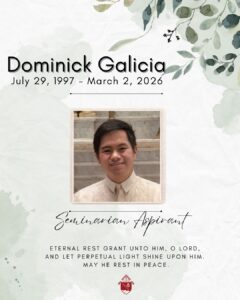 I write to share the sad news of the passing of Dominick Galicia, a discerner with our Vocations Office, who died on March 2, 2026. He was 28 years old. I ask that we keep his parents, his family in the Philippines, and his loved ones in our prayers.